The CARE & Personal Compass Frameworks
Your Tools for Aligned, Meaningful & Sustainable Impact
The CARE Framework is a model I developed to support values-driven, socially conscious business owners, creatives, and leaders who want to create meaningful impact without losing themselves along the way.
It has evolved alongside my work and the people I support, growing into a tool to reconnect with and build trust in your personal compass, the living system that helps you orient your decisions, actions, and pace from the inside out, especially when things feel complex, overwhelming, or unclear.
The Personal Compass Framework is the actionable version of the CARE Framework and helps you stay connected to what matters, interpret what you’re experiencing, resource yourself sustainably, and take action with intention.
Before diving into their details, let’s explore what brought me to develop them.
The Challenge We Face
Most socially conscious, caring people don’t struggle because they lack motivation or commitment. If anything, they care deeply about their work, their communities, and the change they want to see.
The challenge is that many of us spend most of our time acting without regularly checking:
- what we’re sensing,
- how we’re interpreting it,
- or whether we’re adequately resourced.
We live in cultures that reward constant output, self-sacrifice, and responsiveness, often at the expense of attunement and sustainability. Over time, this creates exhaustion, loss of clarity, and a growing disconnect from our personal compass.
Burnout, in this sense, is often a sign of a compass that hasn’t been consulted in a while because of the systemic issues that make it unavailable.
Why the CARE Framework Matters
CARE doesn’t ask you to do more. It invites you to orient differently.
By regularly returning to Connection, Alignment, Regeneration, and Engagement, you develop a deeper trust in your inner guidance and a more sustainable way of working and living.
The framework helps you:
- notice early signals instead of pushing through them,
- make choices that reflect who you are now,
- care for your energy as a finite, valuable resource,
- and take action that feels both impactful and life-giving.
CARE is about cultivating a way of creating impact that is grounded, responsive, and deeply human.
The Foundation: The CARE Framework
CARE stands for Connection, Alignment, Regeneration, and Engagement.
Together, these four areas describe how we sense, make sense, resource ourselves, and act in the world.
They’re not steps to follow in order, and they’re not boxes to check.
They’re ongoing reference points you can return to, again and again, to understand what’s happening and decide how to move forward.
Connection > Sensing
Connection is all about noticing. It includes your inner connection, emotional awareness, body signals, relationships, sense of belonging, and connection with nature or something larger than yourself (if that resonates).
This is where information first arises and where you become aware of it, before decision-making, before action.
Alignment > Interpreting
Alignment is how you make sense of what you’re sensing. It involves your values, strengths, motivations, unique traits, boundaries, and inner narratives.
Here, you translate signals into meaning and orientation, and you define what matters and what doesn’t, so you can make aligned decisions and take aligned actions.
Regeneration > Resourcing
Regeneration is about energy and capacity. It includes rest, play, spaciousness, recovery, pleasure, and the practices or conditions that help you restore energy and resilience.
Without regeneration, noticing becomes harder, and even the clearest alignment and most meaningful work become unsustainable.
Engagement > Acting
Engagement is where insight becomes movement. It’s how you take action, show up, pursue your vision, and contribute to the world.
When engagement is guided by the other three areas, action feels purposeful rather than depleting.
The Practice: The Personal Compass Framework
The Personal Compass is how the CARE Framework becomes actionable in daily life. While the framework names the territory, the compass gives you bearings to navigate it.
Instead of abstract nouns like Connection or Alignment, the Personal Compass uses verbs you can ACT on. Four movements you return to again and again. These are not linear steps, but a back-and-forth cycle that breathes with you as conditions shift.
In my view, your personal compass is your inner guidance system for navigating your business, creative work, and everything else, actually. It’s not a rigid plan or structure. It’s your decision-making framework for aligning actions with your inner truth — your values, principles, inner wisdom, what guides you in life. And it’s a living tool, in that it evolves as you do. When things feel complex, it helps you orient toward what’s true for you, rather than what feels urgent or external demands.
Basically, trusting your compass means returning to yourself as the primary authority for your own decisions. It means both nurturing and rooting into your sense of agency.
The Personal Compass Framework helps you find your way in alignment with your inner truth through four key elements, which are the practical application of the four CARE areas:
- Tune In, where you listen inward to notice what’s alive inside and around yourself.
- Sort Out, where you clarify what matters, what can be let go, and what’s getting in the way.
- Replenish, where you take time to assess and honor your energetic, creative, and capacity needs.
- Step Forward, where you define your next steps and walk them.
The Visual Representation: The Pond Model
Some minds work better with metaphors you can see, but using the parts of an actual compass would’ve made the metaphor too hard to grasp. So, I came up with the Pond Model to give the Personal Compass Framework concrete anatomy and help you visualize it in a clearer, easier way.
Picture a small pond.
There’s the water, of course. Deep down there’s the bottom mud. And on the surface of our pond, three stepping stones emerge.
The bottom mud represents your values, principles, and inner wisdom. It doesn’t shimmer visibly, but it anchors the entire pond ecosystem.
The water, with all its nutrients, is the Replenish stage of the Personal Compass Framework. It nourishes continuously and makes the stepping stones make sense and exist.
The three stepping stones are the other three stages of the framework: Tune In, Sort Out, and Step Forward.
The whole Pond is your Personal Compass.
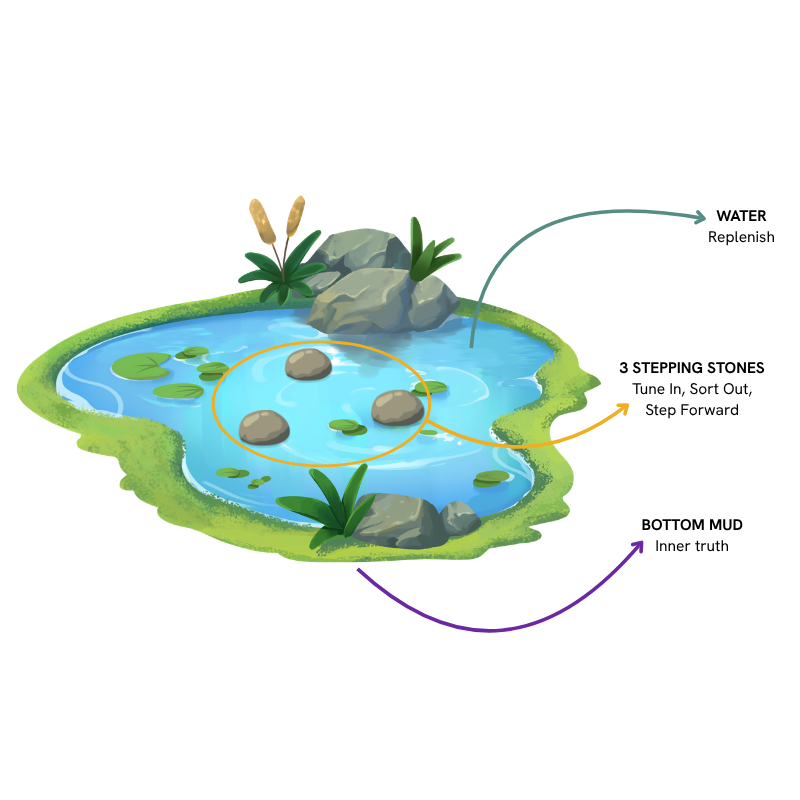
Now, visualizing the Pond helps us understand that the stages are not necessarily sequential. Ideally, one would step on Tune In, then Sort Out, and finally Step Forward, but life doesn’t move in straight lines. You might need to Step Forward before you’re sure if it feels right, then maybe go back to Tune In or Sort Out.
And in any case, going back and forth is key to moving forward to some kind of intention, achievement, or goal while also keeping listening inward to check if you still want to go that direction and sorting out to notice what’s getting in the way. Like in an ongoing feedback loop.
Plus, by visualizing the Pond, we notice that Replenish is not a stone or stage like the others. It’s the water beneath and around all reflections, decisions, and actions. It’s what makes the other stages possible. It’s what helps you regenerate your creativity and capacity, avoid burnout, and build whatever it is that you want to build.
Start using the Personal Compass Framework to bring more impact, joy, and alignment into your biz & creative work
Sign up for a free guided audio journey that will help you rebuild trust in your inner guidance through 5 audios, “async-coaching” prompts for each track, tips on how to work with the prompts, a workbook, and 6 self-reflection cards.